
QHY miniCAM8 Mono Camera Combo


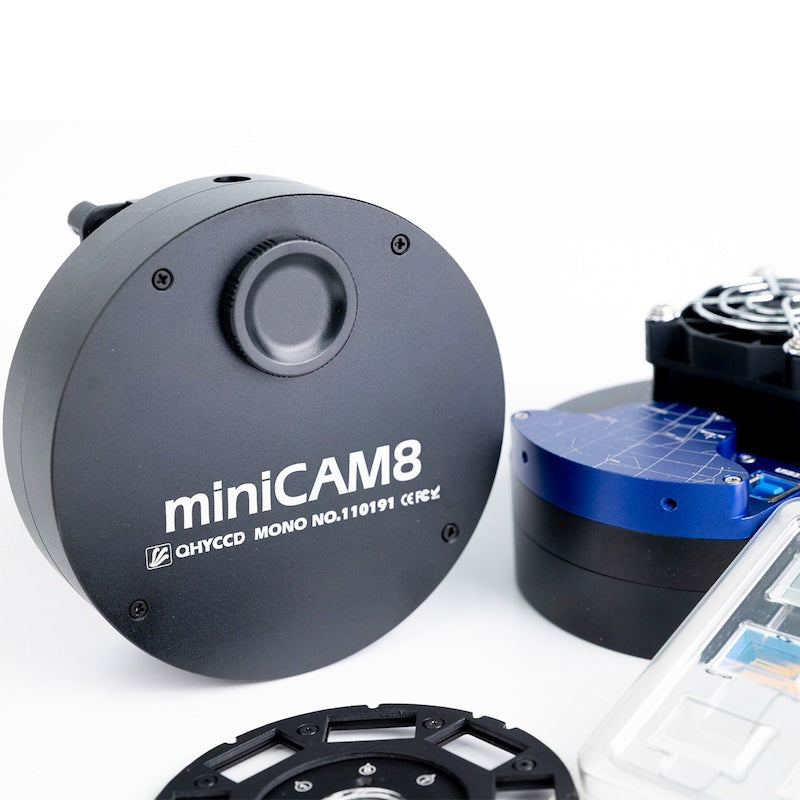
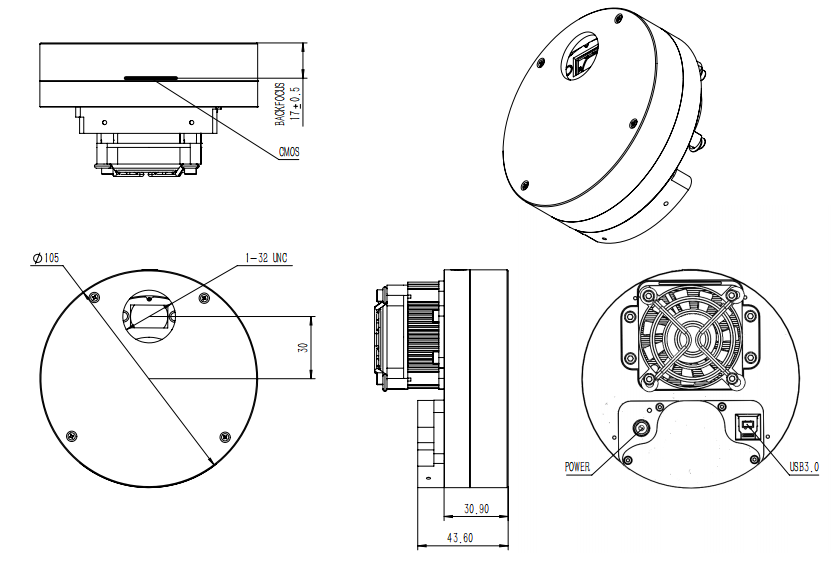


Mono Camera Details
- What's in the Box
- Specifications
What's in the Box
- Camera
- 12V 5A Power Adapter
- Power Cable
- 12V Self-Locking Power Cable
- 1.3m USB3.0 Cable
- 1.25-inch Extension Ring
- Desiccant Tube
- Lens Mounting Clamp
- Screwdriver
- Camera Packaging Bag
- Luminance Filter
- Red Filter
- Green Filter
- Blue Filter
- H-Alpha Filter (7nm)
- OIII Filter (7nm)
- SII Filter (7nm)
Let customers speak for us
Very fast delivery

At first glance it seems quite light and the implication is that it can't really be all that powerful. However, light is what we want and it emits lots of lovely laser light! It's perfect for pointing out features to anyone else and bonus is that you can use a laser to align a scope or binos on the feature of your choosing by shining it through the scope finder or eyepiece (binos).
Just a note it to avoid shining the laser at anything reflective, as it can blind you very quickly. That includes road cones with their reflective tape. I can see how pilots are affected, it wouldn't take much.

Very helpful and knowledgeable team who offered ideas and suggestions without being too pushy. Very helpful.

As a stargazing newbie, I'm so glad I visited the showroom for advice! Andrew was super helpful and I'm very happy with my 8" Dobsonian :)

My comments are based on using it with a 102mm ED refractor, FL 714 mm. My home is in a Bortle 5 location in Christchurch.
This shorty Barlow is an apochromatic design, it uses a brass compression ring and is light at approx.100gms. I've used it several times in mostly poor viewing conditions, and once in above average conditions. In that time I viewed double stars, emission nebulae, open and globular star clusters, and Jupiter. I thought it provided excellent views and on the one occasion when seeing conditions and the city lights were less in the early morning, I was able to achieve 203 x magnification looking at a globular while still getting a reasonable view. Even at 238 x the view was tolerable, albeit quite soft.
I also have a Celestron X-Cel-LX 2X Barlow, so was able to compare the two Barlows. I found them pretty much identical in terms of colour, sharpness and contrast, though someone with better eyesight may notice differences that I can't.
I highly recommend the Astronz 2.5X Barlow, as it can provide substantially higher magnification options if you have, say 3 or 4 eyepieces. Personally, I prefer my 2 X Barlow as its more useful in less than average viewing conditions, which for me is most of the time. However, in above average to excellent viewing conditions, or at a dark sky site, the extra magnification of the 2.5 X Barlow would be very useful. If you are just starting out and wanting to get a Barlow, the Astronz one costs $48 cf. $249 for the Celestron. The choice is pretty much a no-brainer from that perspective.
I'll continue to use both, as different EP combinations and magnification steps will suit different viewing conditions.

The collimator arrived within 24 hours and was exactly what I needed. If didn't take long to realise the collimator itself needed to be collimated which was an easy process and added to learning how to use it. It was easy to use to collimate the Dobsonian Telescope. Thanks Astronz for helping me get underway with my new hobby.

I am so happy with the 8" Dobsonian. The fine focuser and the 2" superview lens where features which other beginner packages didn't have. I went to visit Andrew's store, he didn't confuse me or up sell, and he gave lots of time chatting and showing me the scopes, he gave advice for where to find dark skies and to come along to the societies meeting which introduced me to lots of great people and astronomy. I set the scope up within hours, within a week I had three amazing observing sessions, in dark skies not far from Auckland, the scope is simple and quick to set up and use and I am very impressed by how it has delivered beyond my expectations for power, useability and fun! Highly recommend Astronz
I am delighted to write a report for this product. It is extremely well made and combines a manual as well as electric function for focusing. This is important to me because with my other electric focuser, I was unable to use the telescope visually without having to dismount it. Now I am able to use it visually.
The focusing function allows very precise control. Unlike my previous focuser, there is now no problem from Schmidt Cassegrain mirror slop. I can now search for focus by adjusting in and out of focus and then when focus is found, set the counter to zero. I am a planetary imager and can now be very precise in searching for focus - even during a video capture. When experimenting beyond your "zero" point one can always return to that point precisely.
I have no hesitation in recommending it.
Cheers,
Paul Mallinson

Superbly easy to use and wonderful clear view while abl to clip on phone camera to other side made great photos
From what I’ve tried so far they seem amazing got a few more days to use them in Wellington NZ before we flight back to London so hopefully all good 👍 cheers Frank
I recently purchased the Celestron EdgeHD 8" Optical Tube Assembly from Astronz and had a very positive experience. The sales service was excellent, knowledgeable and provided helpful advice about the telescope and accessories before purchase. Astronz is run by experienced astronomers, which makes a big difference when discussing equipment and setup.


Awesome definition, great contrast and sharpness.

Easy and reliable way to buy.
Perfect and helpful customer service.
The eye piece and the collimator are awesome.